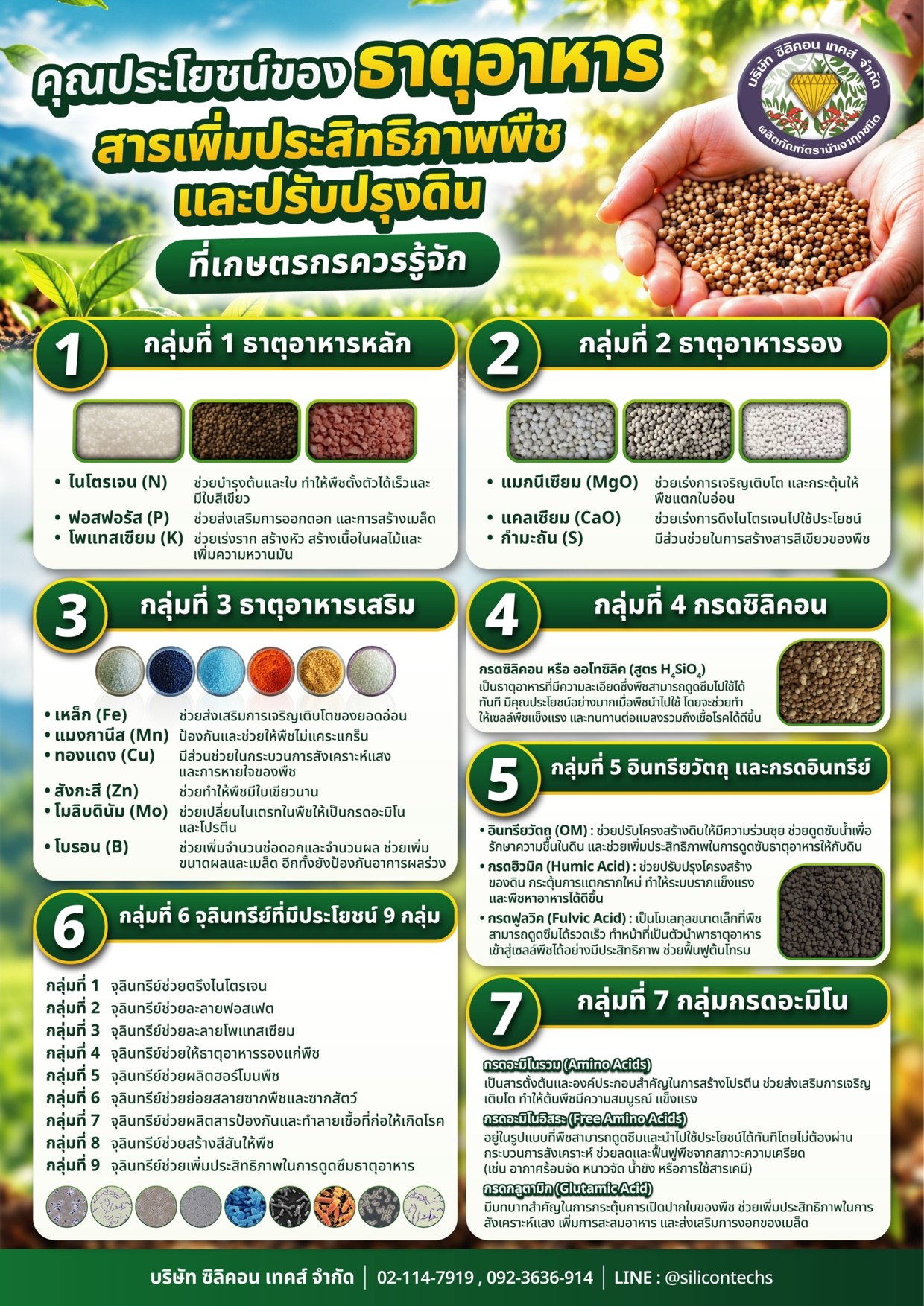
Crops reach their full potential only when they get every group of nutrients, not just N-P-K. If one is missing, yield is held back by that one. Here are the seven groups every farmer should know.
Group 1: Major nutrients
- Nitrogen (N) — feeds stems and leaves, helps plants establish fast with green leaves
- Phosphorus (P) — promotes flowering and seed formation
- Potassium (K) — speeds root growth, builds tubers and fruit flesh, adds sweetness and richness
Group 2: Secondary nutrients
- Magnesium (MgO) — speeds growth and triggers new leaf flushes
- Calcium (CaO) — helps the plant take up and use nitrogen
- Sulfur (S) — helps build the plant’s green pigment
Group 3: Micronutrients
- Iron (Fe) — supports growth of young shoots
- Manganese (Mn) — prevents stunting
- Copper (Cu) — involved in photosynthesis and respiration
- Zinc (Zn) — keeps leaves green for longer
- Molybdenum (Mo) — converts nitrate in the plant into amino acids and protein
- Boron (B) — increases flower clusters and fruit set, enlarges fruit and seed, and prevents fruit drop
Group 4: Orthosilicic acid
Orthosilicic acid (H4SiO4) is a very fine nutrient that plants can absorb and use immediately. It strengthens plant cells and makes crops more resistant to insects and disease.
Group 5: Organic matter and organic acids
- Organic matter (OM) — loosens soil structure, holds water to keep soil moist and helps soil hold nutrients
- Humic acid — improves soil structure and stimulates new roots for a stronger root system that feeds better
- Fulvic acid — a small molecule absorbed quickly that carries nutrients into plant cells efficiently and helps revive weak plants
Group 6: Nine groups of beneficial microorganisms
- Group 1: nitrogen-fixing microbes
- Group 2: phosphate-solubilising microbes
- Group 3: potassium-solubilising microbes
- Group 4: microbes that supply secondary nutrients
- Group 5: microbes that produce plant hormones
- Group 6: microbes that break down plant and animal residues
- Group 7: microbes that produce compounds that protect against and destroy disease organisms
- Group 8: microbes that enhance plant colour
- Group 9: microbes that improve nutrient uptake
Group 7: Amino acids
Amino acids
The building blocks of protein. They promote growth and make plants full and strong.
Free amino acids
In a form plants can absorb and use straight away without synthesising them, helping plants recover from stress such as extreme heat or cold, waterlogging or chemical use.
Glutamic acid
Plays a key role in opening leaf stomata, improving photosynthesis, increasing food storage and promoting seed germination.